

Future of Search in India: LLM Trends 2025 - 2030
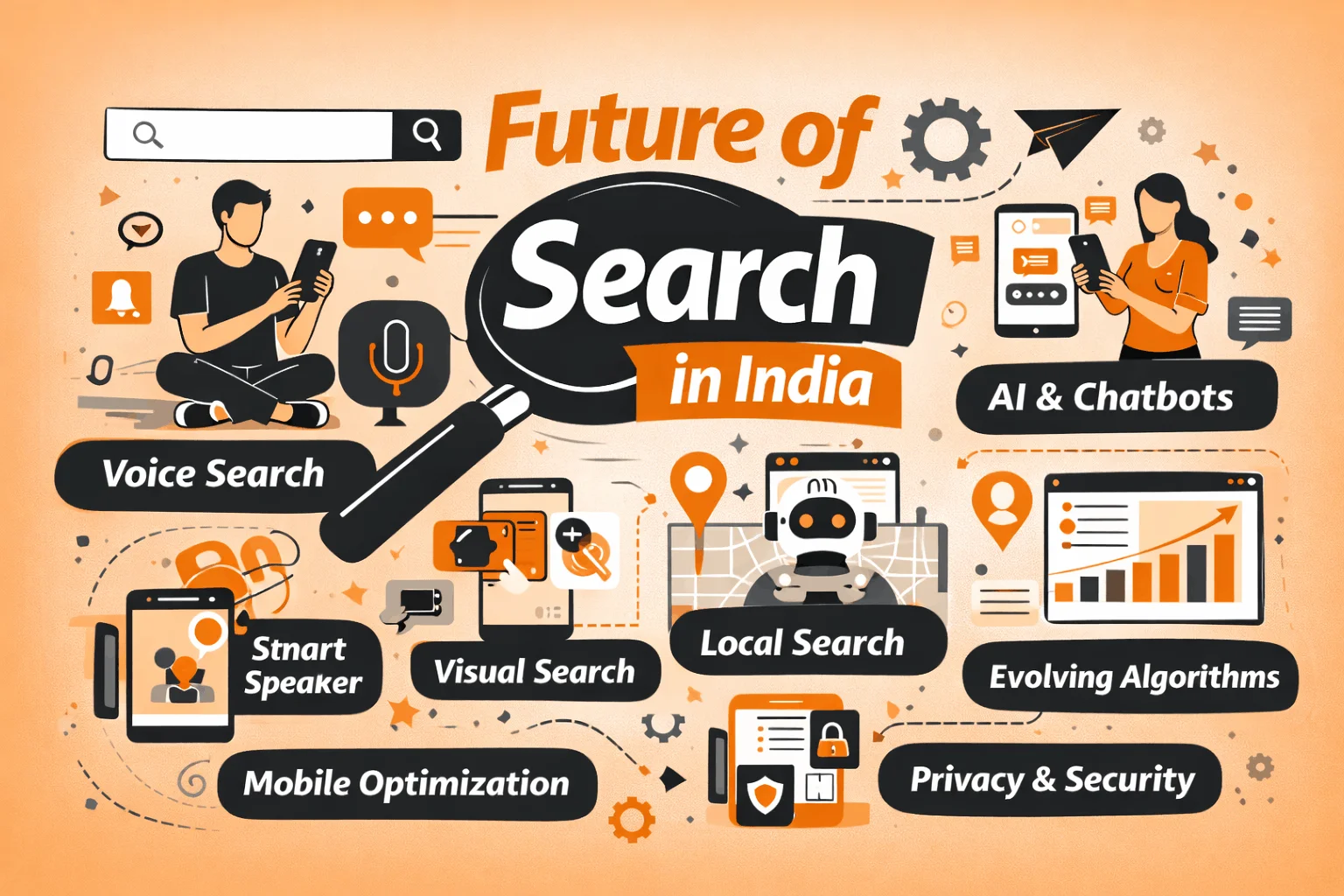 Artificial intelligence with large language models has completely transformed the present-day search system which now delivers intelligent conversational answer engines instead of traditional link-based search results. The digital transformation in India provides better access to information because it develops personalized systems that deliver contextually relevant answers to users who speak multiple languages. The introduction of voice and visual search functions together with predictive capabilities enables users to search for information and businesses to reach their target audiences with greater speed and accuracy. The upcoming 2030 period requires organizations to adopt these innovations because artificial intelligence systems that understand user intent now dominate all user interactions while zero-click search results have become the standard for daily queries.
Predicting the Future of Search (2025 - 2026)
The research investigates how search engines have developed through time. The current state of search technology undergoes major changes because of advanced artificial intelligence systems, especially large language models (LLMs) which create new ways for users to engage with online content. Intelligent answer engines allow users to get relevant answers through conversational interfaces instead of showing traditional search results which include web links. The advanced understanding of user intent by platforms enables users to receive results which match their requirements through an intuitive process. The technology infrastructure in India supports a growing number of digital users who require multilingual access to information through multiple content formats. The standardization of AI tools will change search systems by delivering information through better user-friendly methods which will impact everything from personal inquiries to business decision-making.Search Trends from 2025 to 2030
Artificial intelligence technology will drive major changes to searching methods between 2025 and 2030 which will create more significant transformations than the previous century of technological advancement. The primary online interaction method has shifted to zero-click interactions which enable users to obtain search engine answers without accessing other websites. The future will establish multimodal search as an industry standard which enables users to conduct voice-based natural conversations and object-based scanning for their search needs through various content types such as text and voice and images and video. Hyper-personalization will create customized search results which use individual user data to cover three areas: special user characteristics plus present location plus previously acquired user information.The table presents projected trends through which these developments will be demonstrated.
| Trend | Description | Projected Impact by 2030 |
|---|---|---|
| Zero-Click Searches | Direct answers without needing to click through to sites | Nearly 60% of searches will end without clicks, shifting focus to visibility in AI responses |
| Multimodal Integration | Blending voice, visual, and video inputs | Over 50% of searches conducted via voice assistants, with visual searches handling billions of queries monthly |
| Hyper-Personalization | Customized results based on user data | AI will understand context and mood, leading to fully individualized experiences |
| Predictive Capabilities | Anticipating user queries through data analysis | Integration in devices will handle a majority of informational needs proactively |
It is expected that in 2030, AI systems will handle more than half of the total search query volumes on the planet, while the use of traditional search will decrease by 25% as early as 2026. The increase of vernacular search in languages such as Hindi and Tamil in India will further bolster this trend, as over half of all internet users opt for local languages.
The Way LLMs Are Changing Customer Acquisition in Search
Large language models (LLMs) enable users to execute conversational queries which help them progress toward making purchases thus creating a new search experience. Users can now ask complex questions to receive detailed customized answers instead of conducting multiple separate keyword searches. This means that LLMs could be a game changer for customer acquisition, where brands can interact with prospects at scale through AI-cited content. When you optimize for natural language processing, your content will show up as trusted sources in this narrative and will convert quicker.For instance, in the more competitive Indian market, LLMs enable localization of recommendations for greater relevance. AI-driven search can enjoy conversion rates 4x higher over the conventional ones, and the use of LLM is anticipated to surge from under 5% of queries in 2025 to upwards of 30% in 2028.
Addressing Challenges and Ethical Concerns in AI-Driven Search
Despite that, there are Challenges and Ethics Related to AI-Driven Search Overcoming Challenges and Ethical Concerns in AI-Driven Search. Yes, that was a mouthful! Despite the fact that the future of search really is very bright, LLM inclusion is causing big problems. The “black box” nature of these models also makes it difficult to understand why certain documents are ranked a specific way, which hinders optimization. Accuracy-related issues such as hallucinations when AI generates disinformation, may dissipate its user trust and brand reputation. Training data biases, which are usually heavily weighted toward certain demographics, can adversely affect countries or regions like India, where there is limited local content. Data privacy is one of the ethical considerations, especially with the advent of India’s Digital Personal Data Protection Act that requires companies to be transparent in their handling of user data. Ensuring fairness and accountability in AI outputs is okay so as to not exacerbate inequalities.Adaptation Strategies for Companies to New Search Mechanisms
To prosper in the future of search, companies will need to be proactive in adapting. Think answer engine optimization while using structured data, relevant headings and succinct answers in your content so you can get cited by AI. Experience, expertise, authoritativeness, trustworthiness = E-A-T is important and this is demonstrated via a well detailed author bio and trusted backlinks. Diversify your material(s) by adding multimedia elements such as well-optimized videos and images, as well as implementing technical improvements to enhance loading speeds and crawlability.Focusing on vernacular optimisation can help capture users in India. Numbers indicate that by 2028, AI-driven search has the potential to divert a significant portion of revenues for unprepared brands some estimates quote 50% traffic loss. Track AI results and make unique and opinionated content- that is the way you will stand out.
Leveraging LLM Technology To Define Tomorrow’s Search
Becoming the go-to source for your industry in AI conversations is a major mind-shift necessary to lead in the future of search with LLMs. Results can be influenced even before users visit a site, as companies build quality content that is structured around user intents. It builds confidence in the future and makes acquisition seamless. As LLMs become increasingly integrated into devices, the priority will be conversational optimization, and ethical AI utilization.It is estimated that there will be 76 billion voice searches by 2025 with more than half of internet searches performed by voice by 2030 and AI assistants will be the primary interface. This paradigm shift enables Indian localized innovation leading to a prosperous and ever-changing digital landscape.
In summary, the future of search is one in which people would need to be proactive in fighting the flow of technology (AI, and especially LLMs, moving paradigms from link lists to direct, conversational answers) and in not ignoring how search is changing. Indian companies, as well as others around the world, will now have to focus on creating structured, authoritative, and localized content, or they will find it increasingly difficult to maintain position of visibility and influence in zero-click environments. By addressing ethics issues, including bias and privacy, and leveraging trends such as multi-modal and predictive search, companies can compete successfully for customer acquisition and relevance. The organizations that succeed in this current period will dominate in the upcoming years when smart search systems function as continuous user-required tools that drive both innovation and economic growth until 2030 and beyond.
Read More About:- ChatGPT SEO Strategy for Business