

Lead Gen vs. Ecommerce India 2026
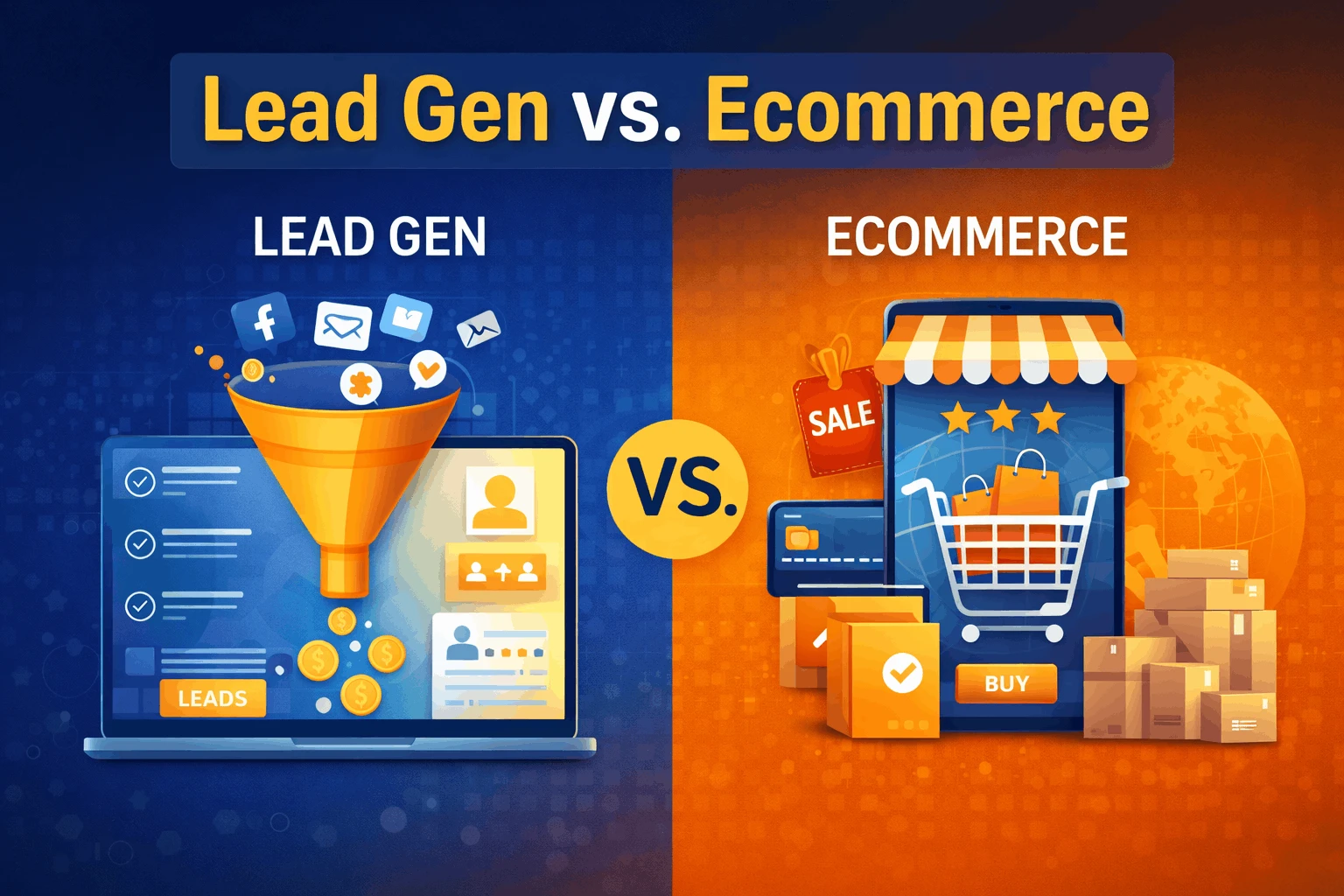 We need to understand these models because the Indian e-retail market will reach about $60 billion in gross merchandise value by 2025, according to Bain & Company, and the lead generation industry will attain a value of $1.5 billion by 2025. The lead generation business model aims to attract potential customers through content offers and forms, while e-commerce brands concentrate on enabling customers to make online purchases through their platforms. The study assesses how lead generation and e-commerce create advantages and disadvantages to assist Indian companies in choosing their best business approach.
Understanding The Core Differences Between Lead Generation and E-commerce
A lead generation website exists to develop enduring connections with customers from B2B or service-based industries who make decisions through multiple people across extended time periods. The e-commerce site exists to enable customers to make immediate purchases because it functions best for products which require straightforward buying. According to industry insights, lead gen marketing strategies invest in building trust through gated content and email nurturing, leading to higher-quality conversions over time. The e-commerce strategy centers on creating operational interfaces which enable users to complete purchases through fast checkout, while its system redirects customers who make spontaneous purchases.The online shopper base in India has grown by 125 million users during the last three years, with an additional 80 million users expected to arrive by 2025. Lead gen campaigns achieve maximum success in real estate and finance sectors, which depend on personalized follow-up interactions to close deals. The e-commerce business has experienced tremendous growth because the FMCG sector expanded by 120% during the 2025 festive season. Companies need to assess lead generation or online purchase methods based on their product complexity because lead generation works best for complicated items, while straightforward, inexpensive products perform better through e-commerce.
InnoMarketers provides services which create customized lead generation and e-commerce client strategies for our clients to achieve the highest return on their investments. Our team assists lead generation businesses in improving their capture forms and nurturing sequences while we help e-commerce brand managers enhance the performance of their sites.
Key Comparison Points
The next table provides fundamental elements which demonstrate the differences between lead gen vs. e-commerce operations.| Aspect | Lead Generation | Ecommerce |
|---|---|---|
| Customer Journey | Slower, focused on nurturing and building trust over time | Rapid, emphasizing immediate purchases and seamless checkout |
| Primary Goal | Capture contact info for follow-up sales | Drive direct online purchases on the spot |
| Marketing Focus | Content marketing, email nurturing, lead gen campaigns | SEO, paid ads, retargeting, e-commerce strategy |
| Suitability in India | Ideal for B2B, services (e.g., 70% higher conversions with ABM) | Suited for retail, FMCG (e.g., 15% CAGR projected to 2027) |
| Revenue Model | Delayed, through qualified leads | Immediate, via transactions |
The table demonstrates that lead generation and e-commerce operate at different speeds with their own distinct methods because lead generation works better in markets that depend on building relationships, while e-commerce functions better in markets that rely on financial transactions.
The Success Strategies Which Work For Indian Business Settings
A lead generation business needs to implement multiple lead generation marketing strategies, which include using intent data, because this approach will produce conversion rates which are 2 to 3 times higher than standard results. New online shoppers from tier-2 and tier-3 cities represent 60 percent of the Indian market, so localized content for lead generation websites will effectively capture these customers.An e-commerce brand needs to develop its mobile capabilities because the smartphone user base will reach 76.42 percent of the total market by 2025. The implementation of quick-commerce models has become essential because the e-commerce industry will reach a value of $274 billion by 2027.
The company InnoMarketers helps its lead generation and ecommerce clients to use both methods by generating leads which help to build customer interest before sending them to the ecommerce platform. All Indian companies which adopted this combined method have developed successful business operations.
Lead Gen Marketing Strategies vs Ecommerce Strategy
Lead generation marketing campaigns are based on content, nurturing sequences, and paid campaigns on LinkedIn, via email, and Google. These include webinars, gated download,s and retargeting to warm leads. Metrics of success are the quality of the lead cost, and the long-term value of the customer.E-commerce strategy is focused on performance ads, retargeting, dynamic pricing, and social commerce. Platforms such as Meta and Google Shopping work well here with focus on ROAS, abandoned cart recovery, and seasonal offers.
In India, lead gen campaigns work well with vernacular content and regional targeting, while e-commerce strategy makes the most of festivals such as Diwali for flash sales. Companies that combine both - and maybe use lead generation or e-commerce hybrid models - generally see the best results to agencies bring these methods together in a way that for clients enables them to execute high-ROI lead gen campaigns in parallel with a sophisticated e-commerce strategy.
Lead Generation versus E-commerce - which is better?
This question doesn't arise because it is not based on superiority, it is based on what is a better fit strategy-wise. The burgeoning digital economy surrounds your business, and there are opportunities for both lead generation and e-commerce to grow, but misalignment could create a waste of resources. Understanding the differences in objectives, designs, and tactics can help businesses produce sustainable engines for growth. Work with professionals to formulate your plan for success. You will be much more successful if your strategy supports your specific needs and drives measurable results in the Indian communities.Read More About:- Performance Marketing in India