

SEO vs Social Media Marketing Comparison For Business Growth
 The online environment of India undergoes continuous transformation, so businesses must discover methods to boost their digital presence. The choice between SEO vs Social Media Marketing Comparison requires companies to make because both strategies enhance their online visibility and customer engagement. The digital marketing comparison guide presents SEO vs social media marketing differences by showing how these methods generate organic traffic vs social media traffic and Google SEO traffic and SEO vs SMM for business growth which companies use to develop. The article delivers insights designed for Indian markets that require website traffic growth in India while acquiring website ranking knowledge and applying AI SEO India and AI search optimization and mastering Google ranking factors for 2026. The article will examine specific platforms by showing SEO versus Instagram marketing and SEO versus Facebook marketing return on investment and of SEO and social media benefits.
Understanding SEO and Social Media Marketing
The process of Search Engine Optimization uses SEO to enhance website visibility on Google search engines during an extended timeframe. The process creates better search engine results through content optimization and technical element optimization and website structure optimization. Social Media Marketing (SMM) uses platforms such as Facebook, Instagram, Twitter, and LinkedIn to build brand awareness and connect with communities and customers directly.The Indian internet population has grown to 900 million till 2026 to make India the largest internet user base among the world that also offers huge business opportunities for Indian companies need to opt for one of the strategies or multiple. India's digital advertising spend will reach around ₹70,000 crores by 2026, thus proving the immense potential for growth in both advertising formats.
Key Differences Between SEO and Social ocial Media Marketing
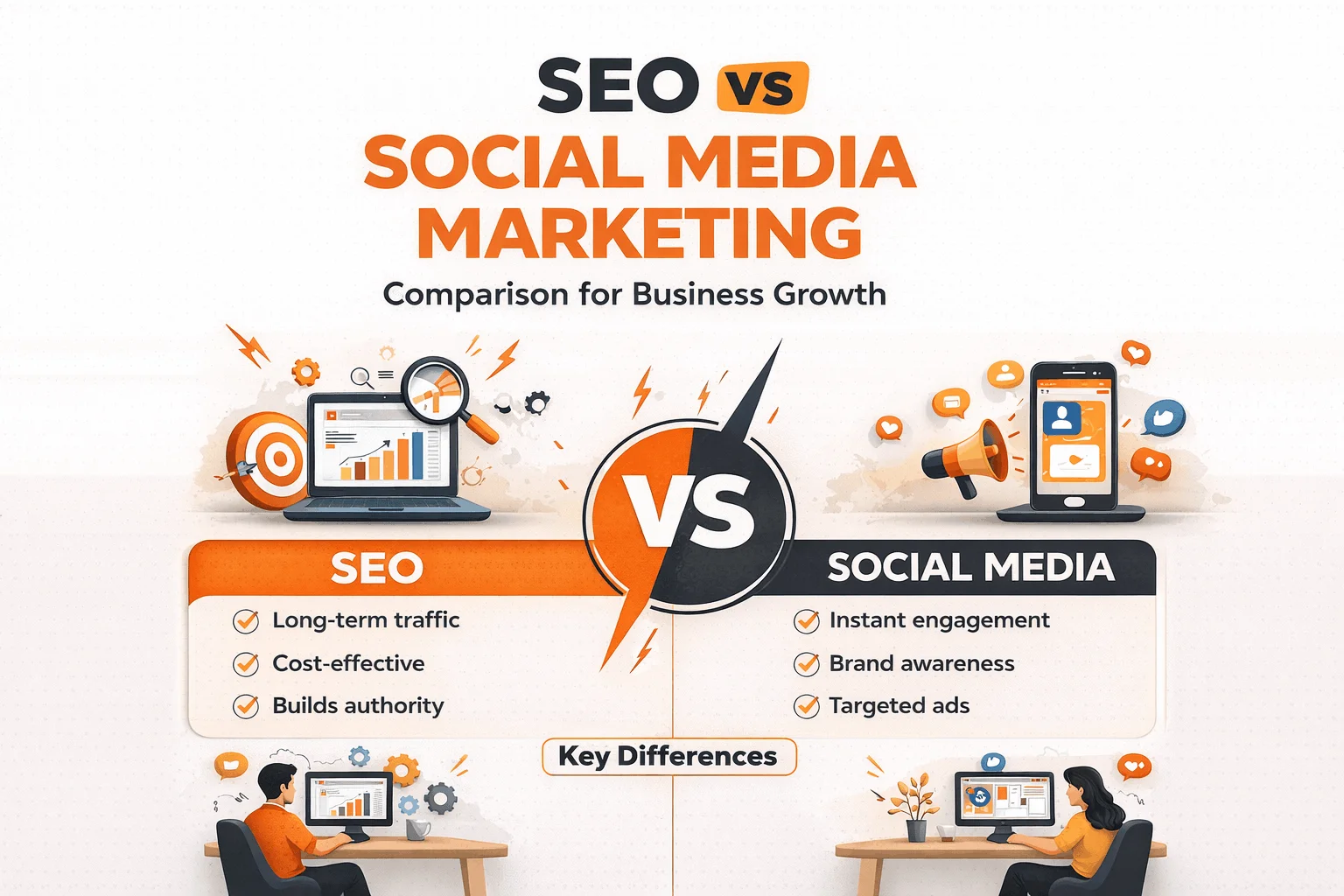
Those who understand the source between SEO vs social media marketing difference are aware that the two areas have separate goals that are achieved through separate methods. SEO provides enduring benefits through Google SEO traffic, which attracts users actively searching for answers. SMM establishes customer connections through online interactions by using content which shows current trends and organizations that need to achieve their objectives.Here is a table that displays important comparison points between two items.
| Aspect | SEO | Social Media Marketing |
|---|---|---|
| Focus | Long-term organic rankings and traffic | Immediate engagement and brand building |
| Traffic Type | Organic traffic vs social traffic: Primarily search-driven, high-intent visitors | Platform-specific, often exploratory |
| Time to Results | Months to years for sustained growth | Quick, with potential viral reach |
| Measurement | Keyword rankings, conversions, backlinks | Likes, shares, comments, follower growth |
| Platform Dependency | Search engines like Google | Networks like Instagram, Facebook |
| Sustainability | Evergreen content yields ongoing benefits | Content lifespan is short, algorithm-dependent |
This table shows what differs between SEO and Social Media Marketing in business growth: SEO provides a solid base, whereas SMM generates viral sensation in a short period of time.
SEO and Social Media Advantages: The Good and the Bad
Each has its own set of advantages when it comes to SEO and social media, but each also has its trade-offs. The Benefits of SEO: It delivers inexpensive, persistent traffic. For example, optimized sites can grab 40-60% of a business’s digital budget allocation for sustained outcomes in India. According to website ranking tips, such as content experience (CX) matching user search intent and E-E-A-T (Experience), quality backlinks, and mobile optimization, these are SEO ranking factors that will impact your site rankings in 2026. Within SEO India, AI-powered tools can improve the relevance of keywords with particular data and help you personalize your content for your visitors based on their interests. The cons of using SEO are that it takes time and effort to learn how to implement it correctly; there is no instant gratification from doing so.Benefits of SMM: Live interaction, which promotes loyalty. Engagement rates for platforms such as Instagram in India range between 1.5-3.5% for business accounts, with D2C brands attaining as high as 5%. For this reason (among others), the social media SEO strategy lends itself to combining organic posts with search-optimized content.
Disadvantages of SMM: Based on algorithms, requires ongoing work. When it comes to SEO vs Instagram marketing, SEO ranks higher for driving targeted organic traffic, whereas Instagram is more popular for visual storytelling for younger consumers in urban India. According to the same, SEO vs Facebook marketing ROI reveals that SEO provides potential high lifetime value of traffic compared to Facebook, which is good for laser-targeted ads—although they both help to increase website traffic India.
Integrating SEO and SMM for Optimal Growth
Businesses in India who understand market trends combine SEO and social media instead of choosing between them. Social media platforms use SEO-optimized blog links to enhance their reach through a social media SEO strategy. Content creators can use AI search optimization to develop content that achieves Google ranking and social media virality. Statistics underscore this synergy: In India businesses that spend 10-20 percent of their budget on social media together with SEO experience equal progress in brand recognition and sales conversions. The AI SEO India trends for 2026 will focus on entity-based optimization together with intent-driven content which uses AI to assess coherence and relevance to create new digital marketing strategies for India-based professionals.Conclusion
The SEO vs social media marketing debate results in a big take away that there is no one best way. SMM stimulates all time customers interaction, on the other hand, SEO provides sustainable traffic for Indian business. Companies can develop a hybrid strategy by learning about social media and Google SEO traffic and using website ranking tips that include Google ranking factors 2026. The most important factor in evaluating SEO and Instagram marketing or SEO and Facebook marketing ROI is whether it matches audience requirements. AI search optimization will drive increased website traffic India, which helps businesses remain competitive in this dynamic marketplace.Read More About:- Social Media Marketing Strategy For 2026