

Technical SEO vs On-Page SEO: Which Is More Important for Better Rankings?
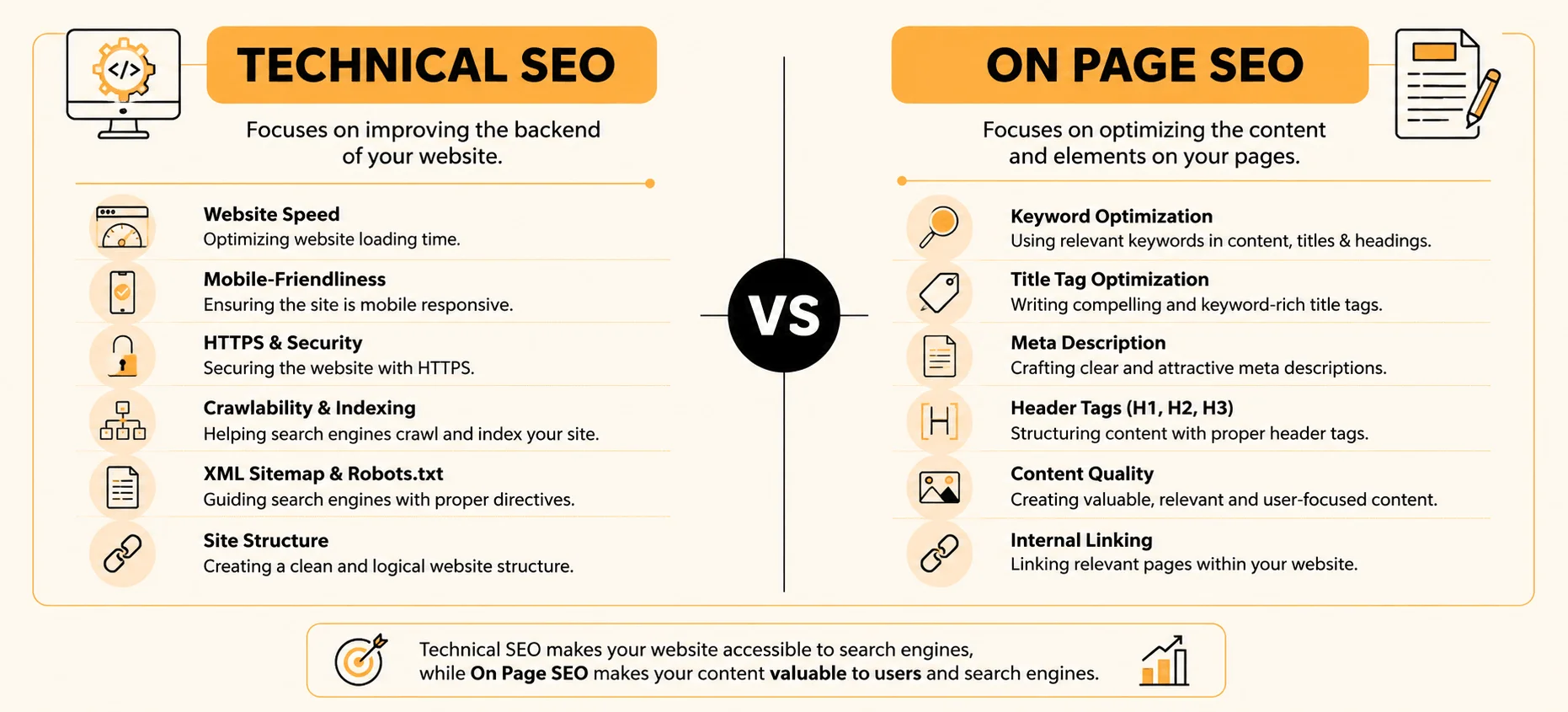 We have witnessed various theories and terminology covering SEO precisely. However, between two crucial strategies, on-page and technical SEO, anyone may fall into the trap of confusion regarding their importance. Therefore, it becomes crucial to understand the difference between them to streamline your entire process based on priority and where you can put more effort for better results.
 The ranking of your pages and website depends on the quality of the search engine optimization strategy you have been following. Whether you are a strategist, beginner, experienced, or even running a business, understanding these two pivotal optimization methodologies can overall improve your entire SEO process.
When it comes to On-Page, it generally covers the overall elements and content optimization for users. Whereas, for the technical part, it generally focuses on the backend elements of your website, like page rendering, indexing, and crawlability of your pages to run your website smoothly and eliminate latency.
So, today, we will be focusing on these two wide terms and knowing the difference between on-page optimization and technical optimization. So, let's begin!
Understanding Technical SEO
When a website’s infrastructure is optimized, which includes various aspects like Crawlability, Indexing, ranking, and many more, search engines can handle every single page easily. Compared to on-page activities, it is not content-focused optimization and generally covers the core backend elements of the website, which improve the performance, latency, site structure optimization, and user experience. Some important aspects of technical SEO include:- Website speed optimization
- Mobile responsiveness
- XML sitemaps
- HTTPS security
- Structured data
- Crawlability improvements
- Indexing management
- Core Web Vitals optimization
Understanding On-Page SEO
On-page SEO is totally dependent on the content optimization posted on your webpages, home pages, service pages, blog pages, and many more. It helps in improving the overall relevance, visibility, and ranking of your pages on SERP through proper keyword stuffing and search queries. However, it helps in improving the consistency of content through HTML elements. It includes- Keyword optimization
- Title tag optimization
- Meta descriptions
- Header tags
- Internal linking
- Image optimization
- Content quality improvements
- URL optimization
Major Difference Between Technical SEO and On-Page SEO
Understanding the difference between these two wide terminologies inside the SEO process becomes essential for building a successful SEO strategy.| Technical SEO | On-Page SEO |
|---|---|
| Focuses on website infrastructure | Focuses on content and page elements |
| Improves crawlability and indexing | Improves relevance and keyword targeting |
| Helps search engines access pages | Helps search engines understand pages |
| Includes speed, security, and performance | Includes content, headings, and metadata |
| Primarily backend-focused | Primarily content-focused |
How Does Technical SEO Work For Better Rankings?
Technical SEO plays a major role in various aspects of the entire ranking of the solution pages to product pages. Without using the technical optimization, businesses may face various hurdles for the search engine to understand their pages precisely.Improved Website Crawlability: The crawlability is the most important part of a website, which helps search engines to understand the clear infrastructure for better navigation of pages. It ensures
- Easier page discovery
- Faster indexing
- Better search engine crawling
- Reduced crawl errors
Better Site Structure Optimization: Creating a powerful and well-optimized structure of a website is very necessary. So, the proper and logical structure of the pages helps in strengthening the authority of the pages. It allows:
- Easier navigation
- Better internal linking
- Improved user experience
- More efficient indexing
Core Web Vitals and User Experience: It eliminates the problem of latency and enhances the experience of users, while prioritizing your website for better signals and rankings. It measures:
- Loading performance
- Visual stability
- User interaction responsiveness
Mobile Optimization: We all know that mobile users are more active than PC users. Therefore, it is a prime duty to optimize the website for Mobile, as google prioritize the mobile first indexing. Technical SEO ensures:
- Responsive design
- Fast mobile loading speeds
- Mobile-friendly navigation
How Does On-Page SEO Work For Improving Rankings?
As compared to technical SEO, On-page SEO generally focuses on improving the website ranking and visibility by posting various types of content on your website. For this, you need to optimize the pages of your website.Content Relevance: Content is the key to successfully operating the on-page SEO and improving the overall authority and credibility of the website. Search engines evaluate:
- Content quality
- Keyword relevance
- User intent satisfaction
- Information accuracy
Meta Tags Optimization: Proper evaluation of titles and incorporating the right keywords in your meta tags helps search engines to understand the relevance of your topic and page. Important elements include:
- Title tags
- Meta descriptions
- Header tags
Keyword Optimization: Before you write or post content on your website, it is necessary to search for high-intent and volume keywords and properly incorporate them at the right density. It includes:
- Titles
- Headings
- URLs
- Content
- Image alt text
- Improved navigation
- Better page authority distribution
- Increased user engagement
- Enhanced crawlability
Which Has More Significance: On-Page Or Technical SEO?
While choosing between these two strategies, businesses or individuals should identify where they are lacking. Additionally, it should be the call of the marketer based on their research work to find loopholes in the content optimization of backend enhancement. However, combining both strategies can maximize the outputs.Without Technical SEO
Even excellent content may not rank because:- Search engines cannot crawl pages effectively.
- Indexing issues may occur.
- Slow loading times can harm rankings.
- User experience suffers.
Without On-Page SEO
Even technically perfect websites may struggle because:- Content lacks relevance.
- Keywords are not optimized.
- Search intent is not addressed.
- User engagement remains low.
Conclusion
As we discussed above, the difference between technical SEO and on-page SEO has been a little easier for you to understand these two wide terminologies, which can be beneficial for your growth. However, balancing these two activities can lead to a massive boost in your website ranking and visibility. Both have an effective and essential for overall improving the authority and rankings on search engines.As technical SEO focuses on the process of crawling pages, indexing, and other reliable backend scenarios, whereas on-page activities majorly revolve around content optimization. Whether you fail to improve the content quality and technical part, both can impact your website's growth. To implement them precisely and in a reliable manner, you can collaborate with DeziFoster, who offers you top-notch SEO experts who assist you in every step of on-page, off-page, and Technical SEO. So it's time to focus on top SEO strategies and drive long-term organic growth.
Read More:- Increase Organic Traffic